Preventing Suicide
School Nurse’s Mental Health Toolkit
One caring person can save a life…
You are that person.


ASK
There is NO EVIDENCE that asking about suicide increases its risk.
Quick Stategies
- Approach with curiosity

- No judgment
- Ask open-ended questions
- Offer hope

Firearms are used in
more than 50% of suicides.
Prevention of suicide involves identifying students who have:
- Thoughts of death or hurting themselves.
- A history of prior attempts.
- A specific plan.
- A family history of suicide.
Risk factors include:
- Bullying.
- Chronic illness.
- Depression or other mental health disorders.
- Inability to obtain care for mental health.
- Societal pressures (racism, poverty, or trauma).
- Stigma and cultural barriers.
- Substance abuse.
- Access to lethal means.
Help them connect.
Always follow your school’s crisis protocols.
Call or text 24/7.
988 for the Suicide & Crisis Lifeline.
To text 988 in Spanish, type “Ayuda” to connect with a Spanish-speaking counselor. For people who speak other languages, call 988 for translation in 240+ languages. This is available 24/7 through voice calling only.
Suicidal Ideation in Students
Suicide rates are higher for:
- Black youth – Rates of suicide for Black youth have risen faster than in any other racial/ethnic group in the past two decades. Persons of color can text STEVE to 741741 to reach a trained crisis counselor, 24/7.
- LGBTQ+ youth.
- Native Americans and Alaska natives. Preventing Suicide: How to Help
- Those with disabilities (due to difficulties in communicating suicidal thoughts)
- Residents of rural areas.
- Youth involved with juvenile justice system or those who have been in foster care.
Ask Students About Suicidal Thoughts
Ask open-ended questions.
 “Sometimes kids feel so low that they wish they were never born. How about you?”
“Sometimes when people feel this bad, they wish they were dead or not here anymore. Tell me about you…”
“Sometimes when people feel this bad, they wish they were dead or not here anymore.
Have you ever done something to hurt yourself or tried to kill yourself?”
Approach with curiosity, not judgment. “This is a horrible way to feel, and there is help and hope for feeling better.” “Thank you for sharing these thoughts. I am here with you.”
Offer hope. “These feelings are treatable. Therapy, learning new skills, and sometimes medication can help.” “You are not alone. Many kids have experienced the same feelings and have gotten better.”
Signs
Noticeable Behaviors
- Withdrawal or reports of severe pain.
- Extreme mood swings, including irritability or anger.
- Giving away prized possessions.
Actions
- Talking about wanting to die.
- Making or researching a plan to die.
- New or increased substance use.
Thoughts
- Frequent thoughts about death or dying.
- “I don’t want to live.”
- “Everyone would be better off without me.”
- “It’s all my fault.”
Academic Signs
- Withdrawal from activities or declining grades.
- Chronic absences.
- Dramatic change from prior performance.
In 2021, approximately 3% of all students reported making a suicide attempt that required treatment.
In 2021, suicide was the second leading cause of death for youth ages 10-14 and ages 20-34.

In 2017, nearly 1 in 5 students had thoughts of suicide. This increased to 1 in 4 during the pandemic.
Resources
For additional resources for mental health conditions associated with suicidal ideation for additional resources for mental health conditions associated with suicidal ideation, scan the code or visit TheREACHinstitute.org. For additional resources about suicide prevention, visit the American Foundation for Suicide Prevention at AFSP.org.
Keep the student safe with you
while you contact school resources.
Connect and communicate with school staff, caregivers, and pediatric clinicians. As a member of your school’s crisis team, know your school’s protocol before a crisis and follow up after referrals.
Safety Planning
Visit SuicideSafetyPlan.com for the The Stanley Brown Safety Plan (also available for download in the Apple App Store or scan the code).
Safety planning is an essential part of treatment.
Having a safety plan that addresses the following is an essential component of a student’s recovery:
- Recognize what puts a student at risk.
- Find coping strategies that do not rely on the presence of others.
- Engage with people and go to places that help distract students away from their problems.
- Reach out to family or friends that can help students in a crisis.
- Keep the student’s environment safe
More About Suicide Screening and Safety Planning
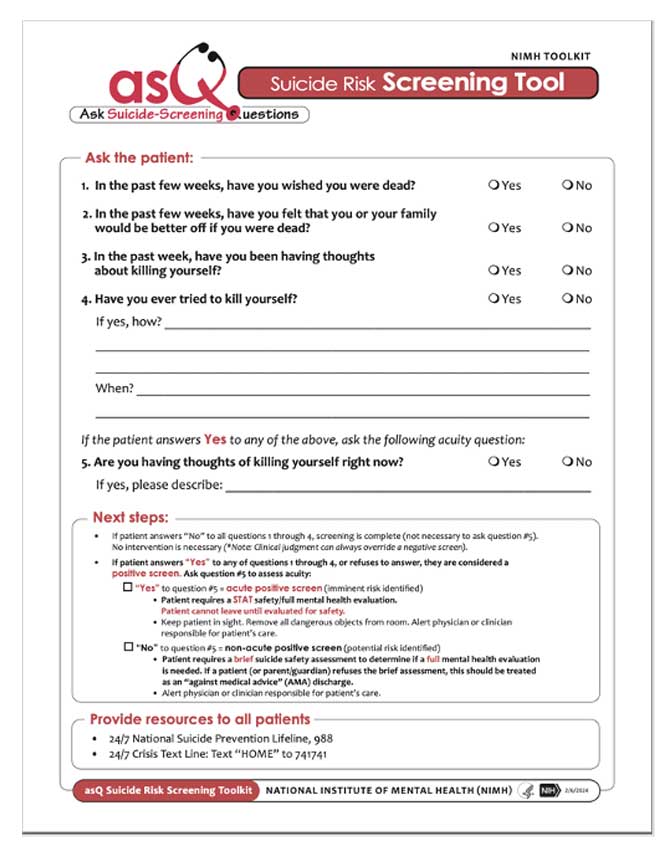
Download the ASQ Suicide-Screening Questions toolkit.
These screening questions can be completed with a student in one minute to determine if they need emergent care.
- School nurses should practice within their school protocols and training.
- How to begin: “I am grateful that you are sharing your feelings with me.
- I’d like to ask a few more questions to understand more.” Then use the form above to review the screening questions.
- Praise the student for sharing information: “This is hard to talk about. Thank you for telling me.”
- Next steps must involve the family. “After speaking with your child, Ihave concerns about their safety because they have shared thoughts about suicide. Can you share your perspective?”
Students who screen positive on the ASQ need urgent evaluation and cannot be left alone. Activate your school crisis protocols.
Safety planning always includes student and family/guardian/trusted adult.
Safety plans are used to support suicidal children and teens. A safety plan is NOT a “safety contract,” or promise, which is not effective and may give a false sense of security. Say:
- “Our first priority is keeping you safe. What can you do when suicidal thoughts start?”
- Discuss coping strategies to manage stress. What works for the student now?
- Discuss with the student and family securing or removing access to lethal means. “Research has shown limiting access to dangerous objects saves lives. How will you secure or remove these potentially dangerous items (guns, medications, ropes, etc)?”
Safety planning is connected to building resilience.
Children will be in distress throughout life, but how can they better cope with distress? How can we help them build their toolbox?
Home Safety Checklist
A home safety checklist helps to protect children at home.
- Safety at home requires decreasing access to lethal means, most importantly firearms. Remind families: studies have shown that many children know how to access the home’s firearms, even when their parents think they do not. Store firearms unloaded in a locked safe with bullets locked separately. Gun safe keys or lock combination should be kept only by adults. When children/teens go to others’ homes, ask homeowners about gun ownership and storage.
- If the student has stated a suicide plan or has made a previous or current attempt, remove those elements from the environment (substances, sharp objects, ropes, razors, and other means of self harm).
- Medications, over the counter and prescribed, should be locked and secured.