General Assembly Day
Advocacy in ActionBegins
Day(s)
:
Hour(s)
:
Minute(s)
:
Second(s)
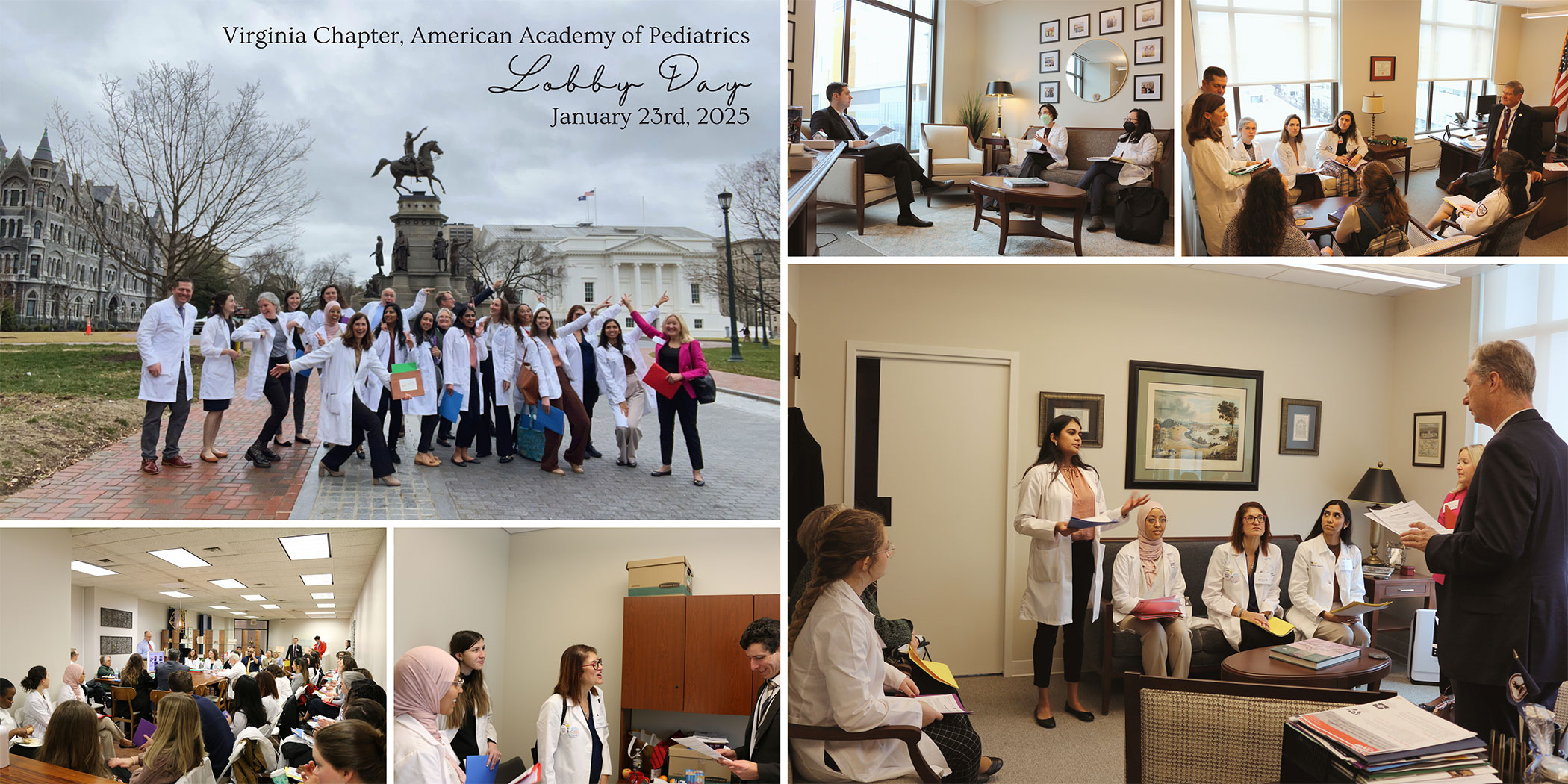
Every year the Virginia chapter of the American Academy of Pediatrics hosts a Lobby Day in Richmond where we set up meetings between legislators and physicians to help lobby for or against pertinent bills. This is a great event to network and also advocate for key pediatric policies. Registration is open to all, including trainees and non-pediatricians. Breakfast and lunch and good company provided! The more the merrier!
Prior to the event we will be sending out prep materials and a previously recorded webinar for anyone registered, but truly no prep is required. Showing up with a white coat and passion for pediatrics is really all that’s needed.
Register
VA-AAP WCD Agenda
7:00 am • Check in of the participants and breakfast at their assigned group table.
7:30 am • Welcome – Natasha Sriraman, MD, FAAP VA-AAP President
7:45 am • Logistics Review – Shevani Sahai, MD, FAAP
7:50 am • Legislative Presentation – Lauren Schmitt and Henry Watkins, Lobbyists
8:30 am • Individual Group Discussion and Preparation
9:00 am • Walk to General Assembly Building, 201 N.9th St. (time for security check)
9:30 am • Scheduled Group Appointments at offices of Delegates and Senators
11:45 am • Return to Larrick Center Meeting Room
Noon • Lunch and Debriefing
1:00 pm Presentation of 2024 Child Advocacy Award–Natasha Sriraman, MD
1:15 pm • VA-AAP Board Meeting Larrick Center Ballroom A/B
3:00 pm • Conclusion
A State Child Healty Policy Agenda for 2025
Priorities and recommendations to foster child health and well-being, achieve health equity, eliminate health disparities, optimize lifespan outcomes, strengthen families, support our communities, and enhance the position of Virginia as a leading sate for children.
Policy Goals
PROMOTE HEALTHY CHILDREN All children, adolescents, and young adults from birth to the age of 26 years must have access to the highest-quality health care, so they can thrive throughout their lifespan. Policymakers must ensure that all children, regardless of their race, ethnicity, income, family composition or immigration status have:
- equitable, non-discriminatory access to affordable and high-quality health care coverage,
- insurance with comprehensive, pediatric-appropriate benefits,
- access to needed primary and subspecialty pediatric care and mental health services, and
- comprehensive, family-centered care in a medical home.
PROMOTE SECURE FAMILIES
Together we can work to advance efforts to ensure that parents can give their children the best foundation for the future. Policymakers must ensure that all families have:
- work that provides a stable and adequate income and family-friendly benefits, including paid family medical and sick leave,
- safe, secure, and non-discriminatory housing,
- affordable and safe high-quality childcare,
- access to adequate, healthy, nutritious foods throughout the year, and
- resources to support family placement and permanency within the child welfare system.
PROMOTE STRONG COMMUNITIES
Strong communities are the building blocks for secure families and healthy children. Policymakers must ensure that communities:
- are safe from violence and environmental hazards,
- provide high-quality early education, especially in segregated urban, suburban, and rural communities,
- support public health systems that protect children from infectious diseases and support maternal and child health, and
- respond effectively when disasters and public health emergencies occur.
ENSURE OUR STATE IS A LEADER FOR CHILDREN
Child health and well-being must be elevated and maintained as a priority in our state. Policymakers must develop and implement policies that:
- acknowledge racism as a public health crisis and work towards reducing racism through interdisciplinary partnerships with organizations that have developed campaigns against racism,
- fund and support public health and health services to help children grow into healthy adults,
- address environmental health and climate change issues that affect children, and
- address factors that make some children more vulnerable than others, such as race, ethnicity, religion, immigration status, sexual orientation or gender identity, and disability.
Advocacy Agenda
Medicaid Payment Parity
Ensure 100% Medicaid-to-Medicare payment parity for pediatric services
- Strengthens the pediatric workforce by addressing pay disparities
- Incentivizes more pediatricians to accept Medicaid, critical for families in rural and underserved areas
- Your constituents gain better access to timely, high-quality care for their children
School Health Access
Fund a full-time school nurse in every public school ○ Extends preventive care and chronic condition management directly where kids are
- Proven to reduce ER visits and absenteeism, issues parents and schools care deeply about
Universal free school meals (breakfast & lunch)
- Reduces both food insecurity for families, and rates of childhood obesity
- Invests in children’s learning, behavior, and health
Maternal & Infant Health
Require insurance coverage for human donor milk in medically necessary cases
- Backed by science, improves survival and outcomes for fragile infants
- A cost-effective, lifesaving intervention when birth parents can’t provide milk
Expand coverage for lactation consultation and support services
- Promotes breastfeeding success, infant health, and maternal wellbeing
- A tangible step toward reducing disparities in maternal health outcomes
Rural Access & Telehealth
Modernize reimbursement to include audio-only telehealth
- Keeps care accessible for families without broadband or smartphones
Allow telemedicine across state lines for established patients
- Essential for college students and mobile families staying connected to trusted providers in Virginia
- Keeps continuity of care without creating administrative burdens
Mental & Behavioral Health
Increase Medicaid reimbursement for pediatric mental health services done by primary care pediatricians
- Supports early intervention and access to therapy in a time of rising youth mental health need
- Helps build a pipeline of providers and reduce burnout among child psychiatrists and therapists
Immunizations
Fair reimbursement aligned with AAP recommendations
- Ensures vaccine availability in all communities
Combat vaccine misinformation through trusted, science-based messaging
- Protects public health, especially in schools and childcare settings
Uphold VDH school-entry immunization requirements based on evidence, not politics
- Keeps schools safe and learning uninterrupted
Government Leadership for Kids
(Re)Establish a Governor’s Children’s Cabinet
- A cross-agency body that prioritizes early childhood, education, and pediatric health
- Include pediatricians as advisors to ensure child health voices inform statewide policy
Our Annual Pediatric General Assembly Day
Was Last Held January 23, 2025